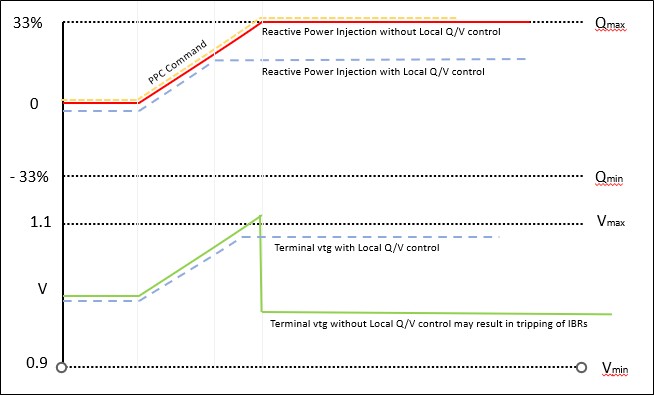
Understanding QV Control: Backbone of voltage stability in RE Projects
In renewable energy plants, controlling voltage at the Point of Interconnection (POI) is critical — and that's where QV Control comes into play.
Most renewable energy sources, such as solar PV and wind, interface with the grid through power electronics converters. These converters are typically controlled as current sources, injecting power into the grid in phase with the grid voltage. This control strategy is known as "Grid-Following".
🔍 What is QV Control?
It’s the relationship between reactive power (Q) and voltage (V) at the grid interface. When voltage at POI dips or rises, your plant must inject or absorb reactive power to bring it back within acceptable limits — as per CEA/CTUIL regulations.
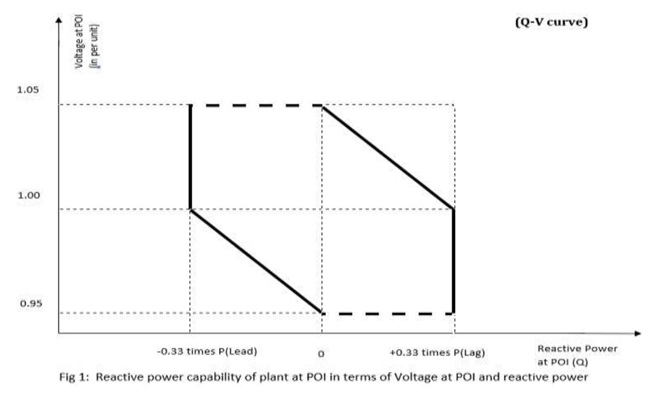
The RE generator should be able to demonstrate dynamic reactive power capability to operate at least up to ‘V-curve’ boundaries (0.95lag/lead as shown in the shaded region) at the corresponding generation level at the POI.
📈 What is the QV Curve?
Let’s break down the curve shown below 👇
- The vertical axis = Voltage at POI (in per unit)
- The horizontal axis = Reactive Power at POI (in terms of P)
According to CEA/CTU guidelines, your plant must be capable of:
- • Injecting reactive power when voltage drops below 1.0 pu
- • Absorbing reactive power when voltage exceeds 1.0 pu
- • Maintaining performance between 0.95 to 1.05 pu voltage range
This is the minimum dynamic reactive power behavior expected from RE plants to maintain grid voltage under fluctuating load and generation conditions.
🛠 How GRIDiNFY Helps
- • QV simulation & tuning using PSS®E / PSCAD
- • Validate reactive performance for CON4 & Trial Run
- • Optimize SVG/STATCOM sizing for weak grid support
- • Ensure your PPC reacts accurately to real-time voltage dips and swells
Recent Posts