Key OEM Requirements for Renewable Grid Integration
Shivtej
QV Control
07 April, 2026
GRIDiNFY provides structured guidelines for OEMs to ensure renewable energy plants comply with grid standards and operate reliably under dynamic conditions.

IBR (Inverter / WTG / PCS / SVG / STATCOM)
General Key Requirements:
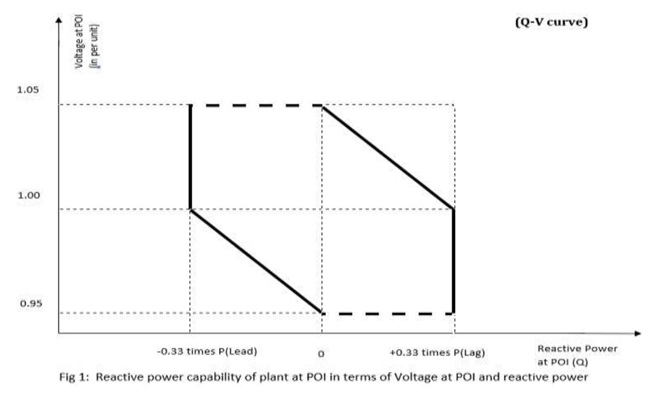
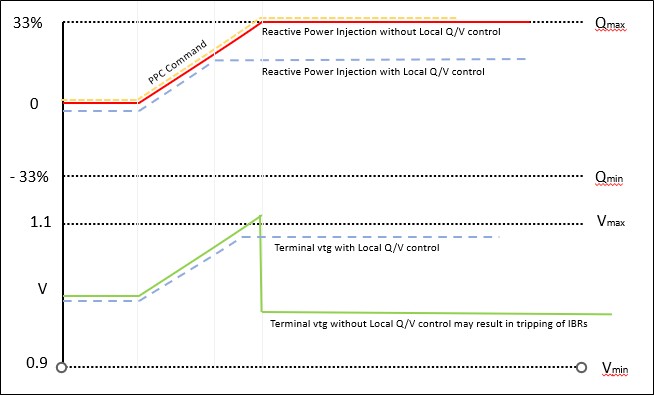
- Local coordinated Q/V control shall be available in line with draft IEGC FTC procedure.
- Inverter shall provide FFR locally and PFR through PPC, coordinated control shall be available.
- High resolution data of accuracy of at least 10ms for at least of 10 seconds recording period must be available for at least last 10-20 event for voltage, current, active power, reactive power, frequency etc.
- Inverter time shall have time synchronization with GPS or Navic up to millisecond accuracy.
- Inverter shall be capable to communicate with PPC not more than 10-100 ms.
- Inverter shall be able to generate timestamp events of LVRT, HVRT, FFR etc.
- Communication protocol shall be IEC61850 instead of MODBUS.
- OEM Should response to consultant/Developer queries in quickly with appropriate technical resolution to it (not more than 24hrs).
- PQ curve shall not be power factor limited for DFIG WTGs instead it shall have complete rectangle capability.
- QV curve shall be provided for complete voltage range of 0.9pu to 1.1pu at-least with full Q capability in lag and lead condition.
- LVRT, HVRT, over, under frequency time stamped SoE shall be available.
PSSE (RMS Models)
- FFR PSSE and PSCAD models shall be available along with relevant documentation, benchmarking and philosophy in line with the IEEE 2800/CEA.
- OEM must share benchmarking reports, model.
- In generic PSSE models if the specific control is not able to represent then required model shall be developed as user defined model and its working, block diagrams along with user manuals to be provided.
- PSSE model shall support PSSE v35 and above.
- In PSSE model, single set of parameters shall be used and shall not be changed based on test conditions, like VDL pairs or any other electrical control, generator controls parameters shall not be modified on case-to-case basis.
- PSSE models shall be numerically stable and shall not cause any non-convergence issues while running.
- PSSE models shall not cause any un-reasonable overshoot, spikes in voltage, frequency, active, reactive power.
PSCAD (EMT Models)
- PSCAD model shall support v5 and above with complier IVF >15 and above and shall be compatible for 64bit and 32bits.
- IBR PSCAD open box model showing IGBT/Converter module shall be available, however IP (intellectual property) related part can be black boxed.
- Both average and switching model shall be provided for PSCAD along with their response comparison for different LVRT/HVRT cases.
- Model shall be able to work for SCR of 5 or lower stably. Be numerically stable for the full operating range including a wide range of grid SCR.
- Negative sequence support and philosophy shall be available along-with formulations and its validated PSCAD models to be shared.
- FDNE benchmarked model in PSCAD shall be provided for harmonic study along with benchmarking report.
- PSCAD model shall be able to work in the range of 5-100us time step without changing its response.
- PSCAD models shall have provisions to create multiple instances of model in same workspace.
- PSCAD model with multiple instances shall not cause slowdown of the simulation.
- Each document shall be version controlled with detailed revision history marking in the document.
- Each simulation model shall be version controlled and model file name shall contain the version number of that release.
- Benchmarking report shall clearly include the model file names, revision history and compatibility of the models.
- Include all relevant control and protection settings i.e. the models shall have all pertinent protection systems modelled in detail for power system transient and voltage stability analysis, including balanced and unbalanced fault conditions, frequency and voltage disturbances. Provision for disabling/modifying the protection systems shall be provided. Further, protection settings like K-factors, LVRT, HVRT, frequency settings, over/under voltage, momentary cessation, ramp rates, local control modes, enable/disable local remote-control mode etc. shall be available to user. MW, MVAR, Voltage Ratings of IBRs & other components shall be clearly included.
- Model user guide including model setup procedure, RMS & EMT software version, compiler, visual studio version etc. shall be submitted along with the model.
- Description of IBR settings with units and range of adjustability for any applicable settings shall be included.
- EMT model shall not contain any dependant libraries. The submitted workspace file (.pswx) must not load any PSCAD library (.pslx) files apart from the PSCAD master library. The model shall be capable of running with no extra steps aside from clicking “Run” option in PSCAD.
- EMT model shall have snapshot capability.
- IBR model shall get initialized not more than 500ms.
PPC (Power Plant Controller)
- Plant controllers’ input, output parameters/reference parameters etc. shall be available to user for view & modification using GUI. Important control functions enable/disable feature shall be available in plant controllers.
- Accurately represent any time delay due to PPC or IBR processing time, polling rates, communication delay etc.
- PPC shall have provision to power oscillation damping (POD) feature.
- PPC PSCAD model shall have the provision to freeze for unbalanced fault conditions.
- PPC PSCAD model shall have the provisions to initialise with predefined P, Q values instead of starting from zero.
- PPC model shall get initialized not more than 500ms.
- It shall have provisions to enable/disable active power control, frequency control, reactive power control etc.
- PPC shall have priority-based despatch provisions for active and reactive power.
- Complete working philosophy of each control shall be documented and shall be included in the PSSE/PSCAD user manual along with PPC operation manuals.
Relevant Standards/Regulations/Guidelines:
CEA Technicals standards for connectivity to the grid regulations
IEGC 2023
Report of Working Group Committee
Recent Posts
QV Control 2025
01 Jan, 2024
Q|V Control 2025
15 Dec, 2025
OEM Guidelines for Grid Compliance
07 April, 2026