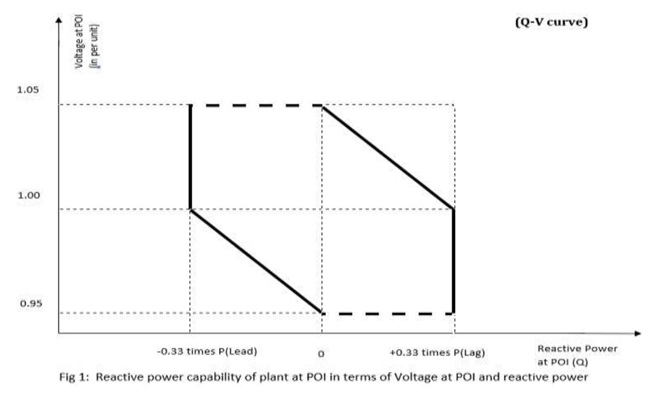
Local coordinated Q|V Control in IBR devices
Local coordinated Q|V control in Inverter-Based Resources (IBRs) refers to a control strategy where IBRs, like Solar Inverters/ WTGs/ BESS, adjust their reactive power (Q) output to maintain the terminal voltage (V) within their steady state voltage operating capability limits.
Reactive power injection (capacitive) or absorption(inductive) by an IBR can be used to either increase or decrease the terminal voltage. Capacitive reactive power tends to increase voltage, while inductive reactive power tends to decrease voltage.
When these IBRs are installed in mega-scale renewable projects, they are geographically spread over many acres of land, typically for a 250MW wind project, the collector system can be as large to 200-300kMs. Considering this, there is a remote possibility to have same voltage profile across all the IBRs same. The voltage variations can be 10-15% higher at far end IBRs wrt. POI. However, this problem can be less severe in the central inverters case. But, if evacuation transmission line is long enough then it can be witnessed in the solar parks having central inverters as well.
As far as reactive power capability of IBRs is concerned, typically for a type-3 WTG, it varies roughly from 33% to 40% of active power, whereas for solar/BESS inverters it is 60% of active power.
Different countries have their own grid code for reactive power requirements. As far as Bharat (India) is concerned, the reactive power requirement from renewable plant is at-least ±33% of active power at POI.
Usually, PPC is used to control reactive power centrally for the renewable plant wrt. POI need, PPC broadcasts the command equally to individual IBRs via different communication protocols (typically now as days MODBUS TCP/IP and IEC61850).
For such mega scale level projects, when PPC send command to IBRs for an instance say command for injection of reactive power, due to communication loss some of inverter may cross limits of HVRT state without even any faulty condition, Resulting tripping of a system.
That’s the point, Where locally coordinated Q|V control comes in picture limiting the reactive power injection/absorption of reactive power withing the limits as per IEEE ensuring terminal voltage stays in limits avoiding tripping of system.
🛠 How it Works
-
Voltage Measurement
The inverter continuously measures terminal voltage at the PCC.
-
Local Q|V Controller
A local control algorithm compares the measured voltage against a reference voltage.
- If voltage is too low → Inject +Q (capacitive)
- If voltage is too high → Absorb −Q (inductive)
-
Reactive Power Limiter
Ensures reactive power stays within inverter limits:
- Avoids exceeding current limits
- Prevents voltage instability from overcompensation
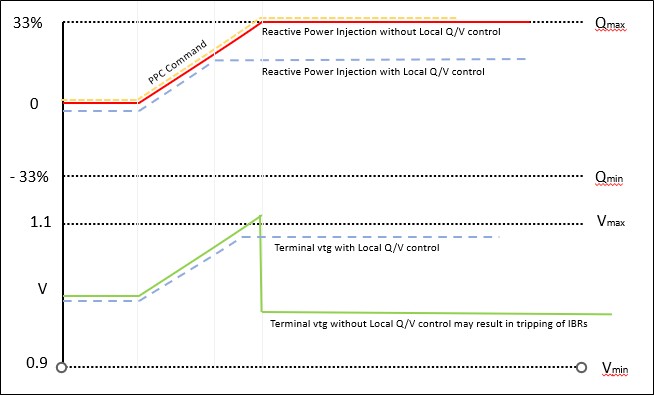
For example, if the voltage is low, the inverter might inject reactive power to raise the voltage, and vice versa.
1. Without Local co-ordinated Q|V control
Reactive power is controlled centrally and perform insufficient during fast voltage disturbances
As a result, reactive power ramps up and hit limits (Qmax/Qmin) (limits according to CEA standards connectivity to the Grid) it may enters HVRT/LVRT mode further resulting in tripping of system in plant after specified time.
2. With Local co-ordinated Q|V control
With the help of Local co-ordinated Q|V control reactive power injection/absorption happens more precisely at by individual inverters maintaining the limits specified in CEA regulations connectivity to the grid resulting voltage stability and unnecessary tripping of system.
Benefits of Local Coordinated Q/V Control:
-
Local control can quickly respond to voltage fluctuations, preventing voltage sags and swells that can affect sensitive equipment.
-
By coordinating local actions, the overall voltage profile of the grid can be improved, reducing voltage variations across different locations.
-
Improved voltage regulation contributes to the overall stability and reliability of the power system.
Recent Posts